
Topic: Film forming for in-mold decoration (IMD / IML / film insert molding)
IMD & IML Thermoforming Machines: Process, Film Forming, Die Cutting and Applications
Using the published specifications of SANSEN machines, this guide walks through an IMD/IML film from printing to injection molding and shows exactly which step a hot press forming machine performs, which belongs to a high-pressure gas forming machine or a 3D die-cutting machine, and which must be done on an injection molding machine.
1. IMD, IML and IMT: what the terms mean
In-mold decoration covers processes that bond a decorative layer to a plastic part during injection molding. An article by CMF设计军团 published on Puxiang notes that the Chinese industry often uses IMD as the umbrella term, covering IML, IMF, IMR, INS and others, and splits them into transfer processes (IMR) and processes in which the film stays on the part (IML/IMF/INS/IME) [1].
International usage differs. In Nissha’s documentation and in Plastics Decorating, IMD usually means roll-to-roll transfer: a printed foil is fed through the mold, only the ink layers transfer to the part and the carrier film is peeled away. IML means a printed film that is pre-formed and trimmed, then placed in the cavity, where it stays as the part’s outer skin [2][5]. Niebling adds that film insert molding (FIM) has no registered name, so IML, IMF and INS often describe the same process, while IMD is a generic term for decoration [4]. The safest question to ask a customer is therefore: “Does the film remain on the finished part?”
| Process | Film stays on the part? | Separate forming and trimming? | Where SANSEN machines fit |
|---|---|---|---|
| IML / IMF / FIM (film insert molding) | Yes, the film becomes the outer layer [2][5] | Yes: print, form, trim, then insert into the mold [2][4] | Hot press or high-pressure gas forming machine for forming; 3D die-cutting machine for trimming |
| INS (insert film molding) | Yes; usually thicker ABS or PMMA+ABS film [1] | Yes: pre-heat, form, trim, insert. The source says INS generally needs only medium-pressure forming, while IML needs high-pressure forming [1] | Choose hot press or high-pressure gas forming by film thickness and draw depth |
| IMR (in-mold roller / transfer) | No: the carrier is peeled off, leaving the protective and graphic layers [1] | Normally no; a foil feeder brings the transfer foil into the injection mold [1] | Mainly an injection machine plus foil feeder – not a core application for SANSEN hot presses |
| IMT | No: the carrier is peeled off and the graphic layer transfers to the part [1] | Yes: the source describes IMT film being heat-formed and trimmed before injection [1] | Forming and trimming steps |
| IME (in-mold electronics) | Yes, with printed conductive traces and components such as LEDs [1][5] | Yes: print circuits, form, trim, mold [4] | Forming and trimming; tighter registration requirements |
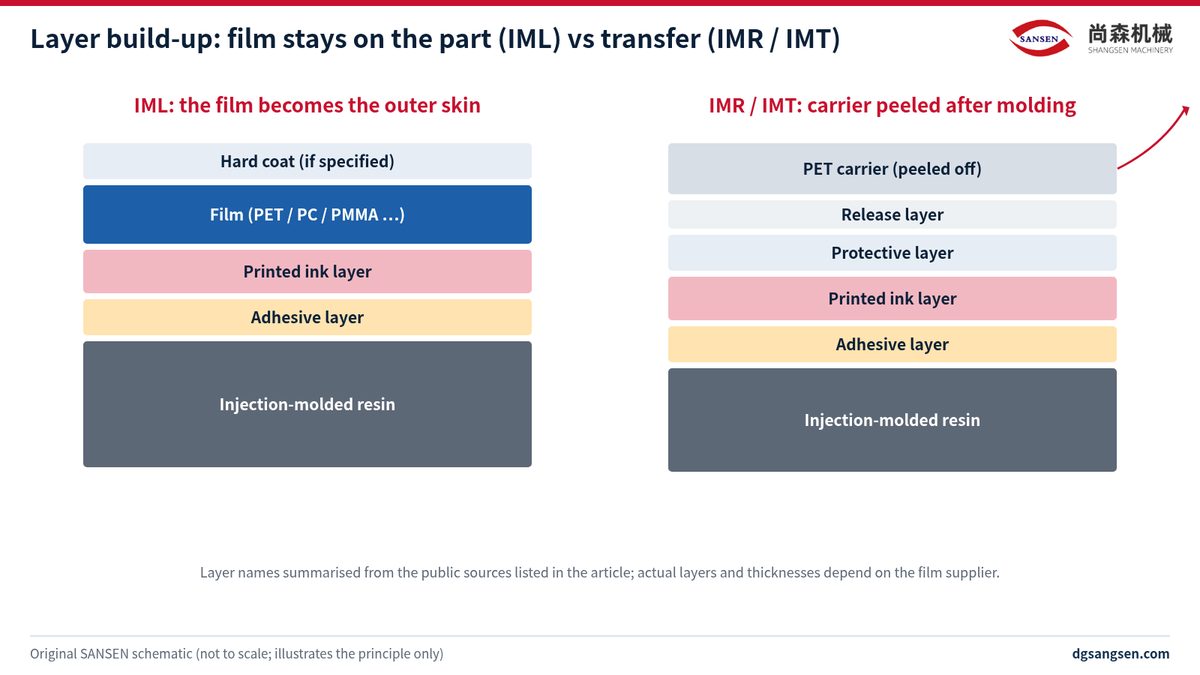
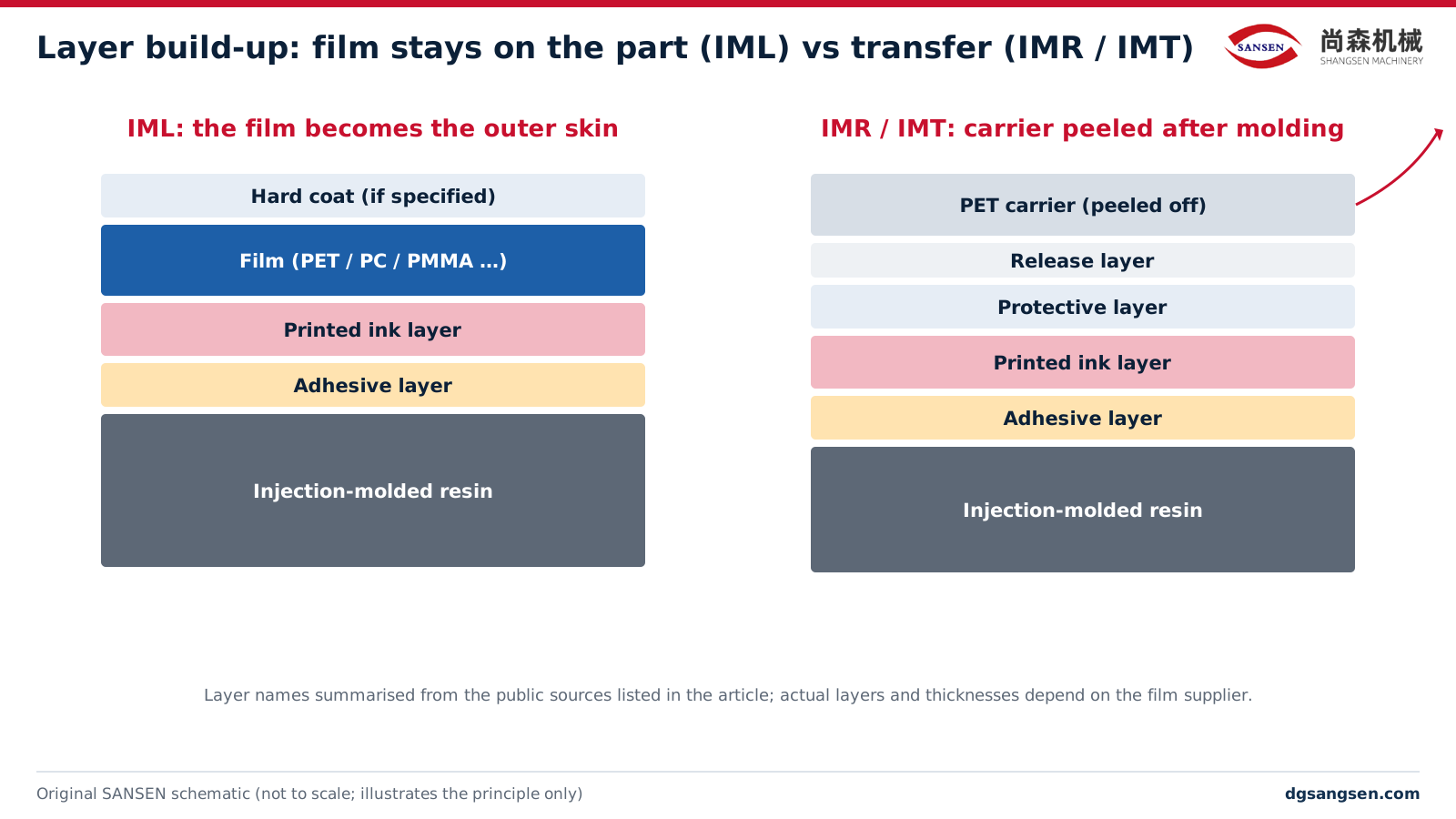
In short: any process that turns the film into a 3D shape before it goes into the injection mold (IML, IMF, INS, IMT, IME) needs dedicated film-forming and trimming equipment. Pure roll-to-roll transfer relies mainly on the foil feeder of the injection molding machine.
2. How a hot press forming machine works
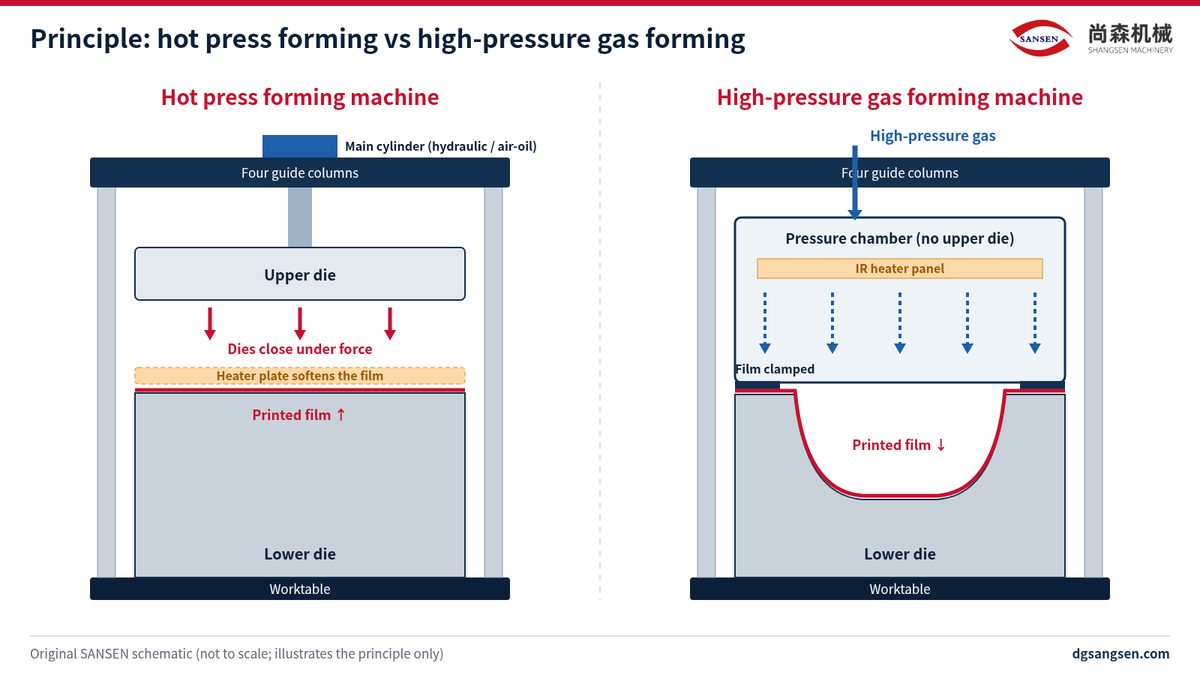
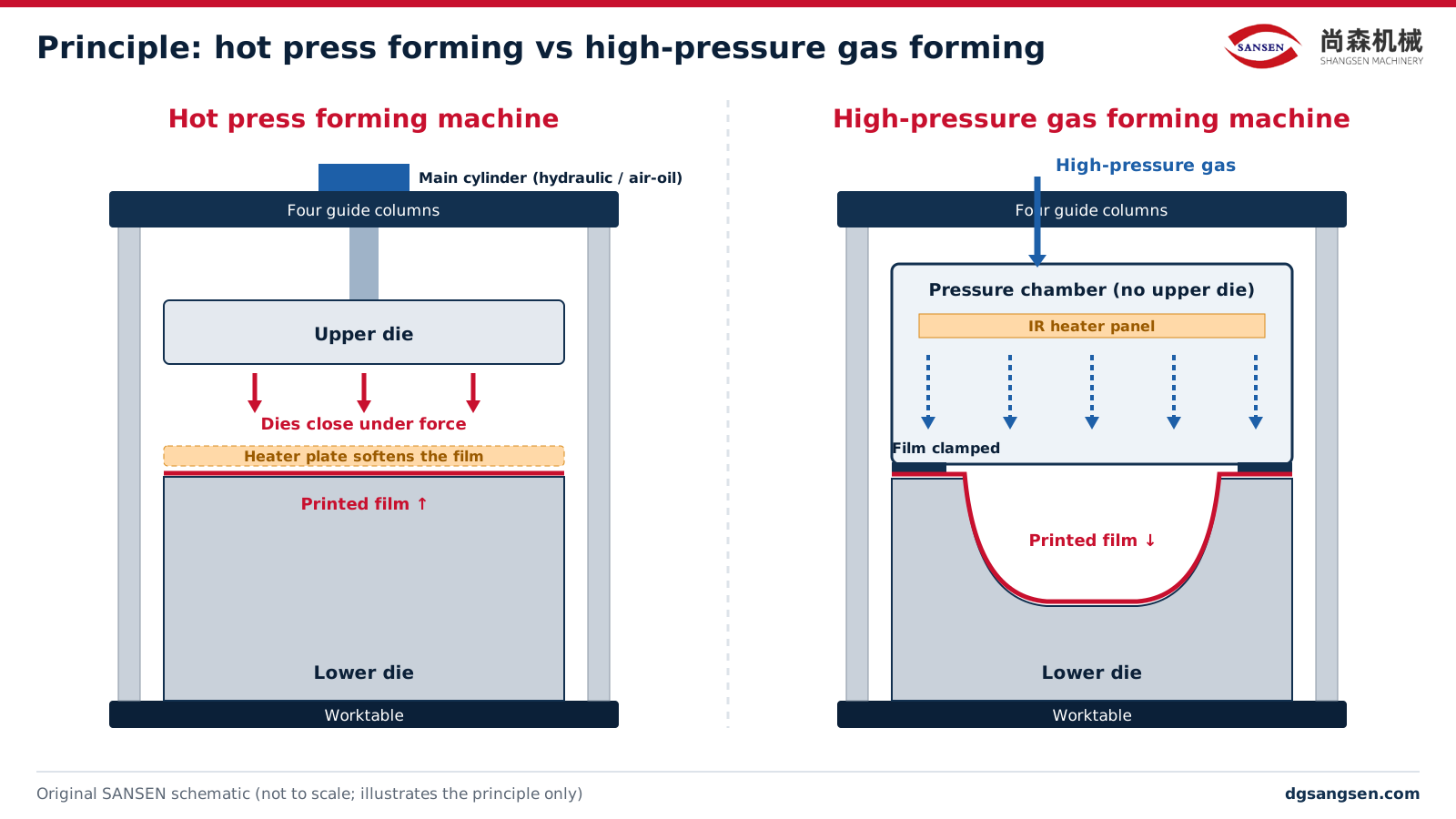
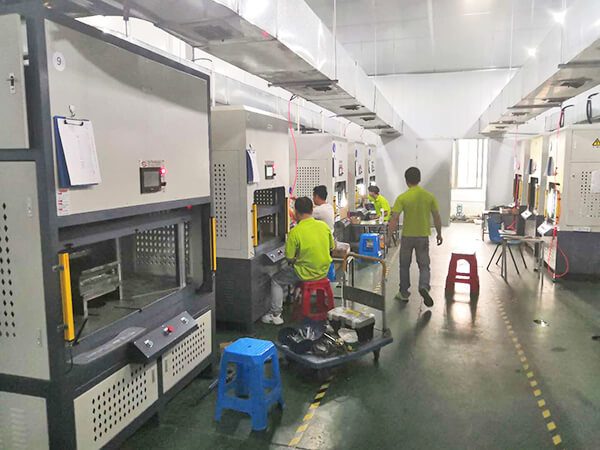
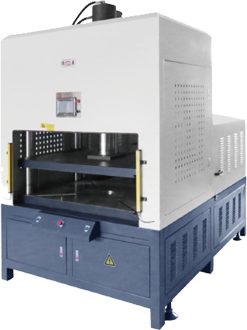
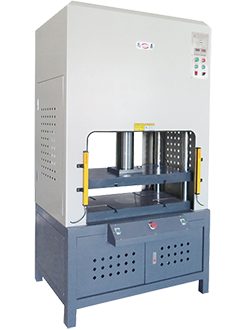
A hot press forming machine is a press with a heating system. It heats a printed film sheet until it softens, then the main cylinder closes the dies at a set force and holds them so the film takes the shape of the tool. After it sets, the press opens and the formed film is removed. The machine does not melt plastic or inject resin, which is the basic difference from an injection molding machine.
One cycle on a SANSEN hot press forming machine
- Loading and locating: the printed film is placed on the lower die using locating holes or a fixture.
- Heating: the heater plate heats the sheet. SANSEN’s hydraulic IMD hot press page describes uniform far-infrared radiant heating, a constant-temperature stage, then instant forming by the hydraulic cylinder, with carbon-fiber heating tubes [S]. The AS201F table lists the heater plate drive as “Inverter + synchronous motor” [S].
- Closing under force: depending on the tonnage, the AS201F series uses a hydraulic HOB cylinder or a fast master-slave cylinder [S]. The gas-liquid hybrid model uses air-oil boosting with a preset fast-to-slow change-over [S].
- Setting and opening: after the hold time the press opens and the formed film goes to trimming.
Temperature, time and force can be set and stored. The AS201F uses “Touch screen + PLC” control [S], and the advanced configuration of the gas-liquid hybrid model stores forming hold time, heating time and heating temperature as numbered recipes [S].
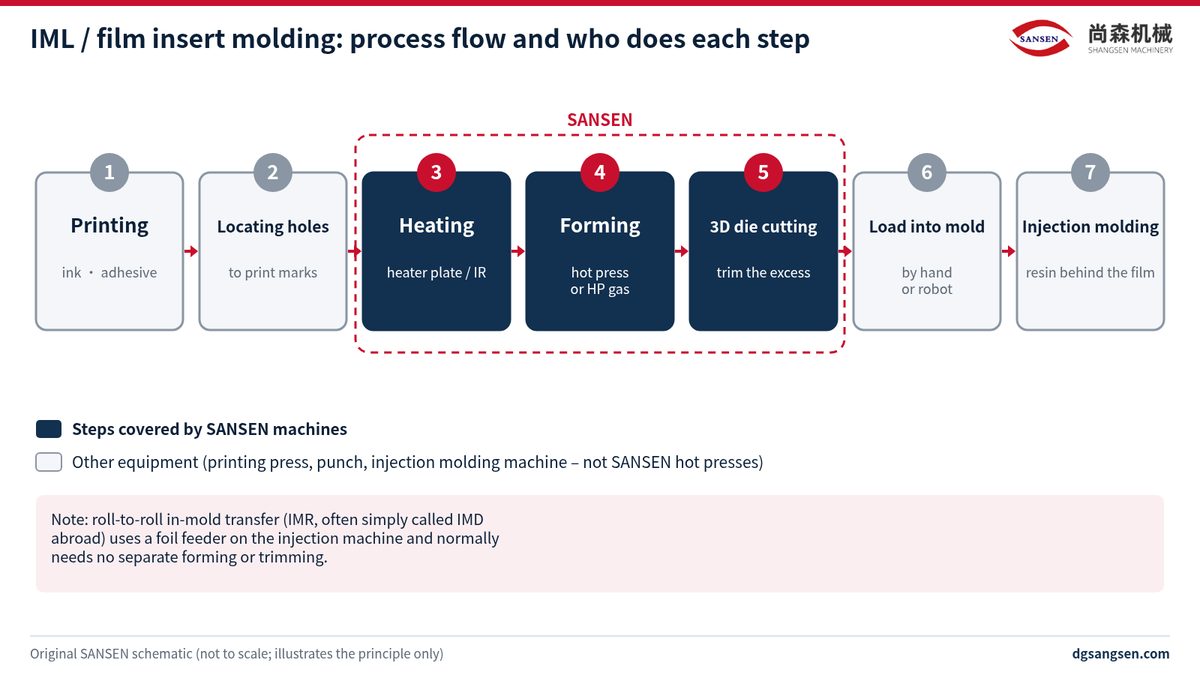
3. Process flow: printing, heating, forming, trimming and injection molding
| Step | What happens | Equipment | Watch out for |
|---|---|---|---|
| 1 Printing | Graphics, ink and adhesive layers are printed on the film, typically by screen or gravure/four-colour printing [1][2] | Screen printing machine from partner LICHAO: automatic sheet screen printing machine with CCD or LC-FZSYJFG-6060 roll-to-roll screen printer (sp.catekvo.com, not SANSEN equipment); UV texture transfer: LICHAO LC-500UVZY / LC-600RLUV | Inks must survive forming stretch and molding heat [5] |
| 2 Locating holes | Holes are punched relative to the print so the graphic lands in the right place after 3D forming [4] | 2D punch | Hole-to-print registration |
| 3 Heating | The sheet is heated into its softening range [3][4] | Heater plate of a hot press / IR panel of a high-pressure gas former | Too cold can crack the hard coat; too hot can blur the graphic [6] |
| 4 Forming | Matched-die pressing or high-pressure gas presses the film onto the tool | SANSEN hot press forming or high-pressure gas forming machine | Draw depth, radii, graphic registration [6] |
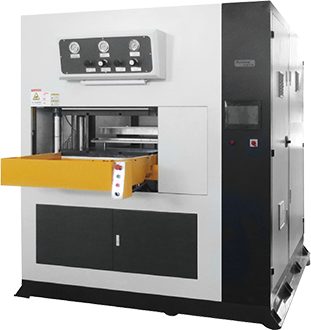
| 5 3D die cutting | Excess film is trimmed so the insert fits the injection cavity [2][4] | SANSEN 3D die-cutting machine | Locate on formed features, not on the graphic [6] |
| 6 Loading | The insert is placed in the cavity by hand or robot [1] | Molding shop | Coverage must keep the film out of the parting line and avoid edge light leaks [5] |
| 7 Injection molding | Resin is injected behind the film and bonds to it | Injection molding machine (not SANSEN) | A poorly placed gate can wash out the ink [5][6] |
4. Materials and how to choose them
Common films in the public sources: Nissha lists PET, PC and PMMA+ABS (laminated) as IML surface films [2]; Plastics Decorating lists polyester, polycarbonate, acrylic and acrylic-capped PC [5]; INS films are usually ABS or PMMA+ABS [1].
Materials named on SANSEN product pages: the high-pressure gas forming machine is intended for PC, PC+PMMA and ABS+PMMA [S]; the hydraulic IMD hot press targets PET, PVC and similar film sheets [S]; the 3D die-cutting machine is used for PET, PC, PVC and other plastics [S].
- Start from the surface requirements. Scratch, chemical and environmental resistance decide the film and hard coat, because the film is often the first surface the user touches [5].
- Check the draw depth. Excessive stretch can thin inks until they turn translucent and can reduce hard-coat chemical resistance [5]; PET suits flat or shallow parts [6].
- Check the bond to the molding resin. In service the film-to-resin interface fails most often, so match the tie layer to the resin and run adhesion tests [6].
- Matte or textured films: conventional thermoforming can make matte films look glossy and damage textures; high-pressure forming (HPF) handles them better [3][4].
- Sample with your real film. Forming windows differ by brand and thickness, so this article does not quote generic temperatures or pressures detached from a specific material.
5. Key factors: tooling, temperature, pressure and time
| Factor | What it affects | Adjustable on SANSEN machines (published data) |
|---|---|---|
| Tooling | Surface accuracy, radii and locating method decide the formed shape and graphic position; IML injection molds also need dedicated changes [5] | Upper and lower molds preheated with independent control on the high-pressure gas former [S]; T-slot tool clamping [S] |
| Temperature | How far the film softens, hard-coat cracking, graphic sharpness [6] | AS201F adjustable temperature Room temp. – 400 ℃ [S]; AS201F-G IR heater Room temp. – 500 ℃, upper/lower mold plates Room temp. – 150 ℃ [S] |
| Pressure | How fully the film follows the tool and how sharp the radii are | AS201F force 5 / 10 / 30 / 40 / 80 t [S]; AS201F-G two-stage high/low gas inlet with independently adjustable flow and hold time [S] |
| Time | Heating and hold times affect forming completeness and cycle time | Numbered recipes for hold time, heating time and temperature on the gas-liquid hybrid model [S] |
| Parallelism and accuracy | Consistency of forming and cutting | AS201F-Z platen parallelism (any point) within 0.05 mm [S] |
For orientation only: Sabreen quotes typical film pre-heat values of about 160–190 °C for thermoforming PC and about 120–150 °C for high-pressure forming, a useful starting point for discussion with your film supplier [6]. The real process window comes from the film data sheet and sampling.
6. Hot press forming vs high-pressure gas forming
| Item | Hot press forming (SANSEN IMD/IML hot press) | High-pressure gas forming (SANSEN AS201F-G) |
|---|---|---|
| Forming force | Main cylinder closes upper and lower dies [S] | High-pressure gas presses the softened sheet directly onto the lower mold [S] |
| Tooling | Upper die + lower die | Lower mold only, no upper mold [S] |
| Heating | Heater plate with carbon-fiber heating tubes [S] | IR ceramic heater panels with multi-point PID control; upper and lower molds preheated independently [S] |
| Published pressure data | Force 5 / 10 / 30 / 40 / 80 t (AS201F) | Gas source 0-4MPa (80T), 0-8MPa (250T) [S] |
| Graphic registration | — | Sources report that HPF keeps printed symbols more precisely positioned, and forming distortion can be compensated by distortion printing [3][4] |
| Applications listed by SANSEN | Appliance panels [S], smart-lock panels [S], phone cases [S], 2.5D protective film (roll feed) [S] | Automotive clusters and IMD/IME interior and exterior trim, appliance control panels, phone and electronics housings, irregular deep-drawn parts [S] |
How to choose: for flat or shallow panels with moderate registration needs, where investment and cycle time must be balanced, evaluate hot press forming first. For deeper draws, symbols that must land precisely, composite sheets or matte/textured films, evaluate high-pressure gas forming first [3][4]. Confirm with samples.
7. Common defects and troubleshooting
| Symptom | Typical causes | What to check |
|---|---|---|
| Graphic out of register with the shape | Forming distortion not compensated; trimming located on the graphic instead of formed features; different shrinkage between film lots [6] | Use distortion printing [3]; locate trimming on formed features; control film lots and storage [6] |
| Wrinkles | Uneven heating, loose clamping, draw too deep for the radius [6] | Re-balance heating, tension the film, open up the radius or switch to high-pressure forming [6] |
| Bubbles or delamination | Moisture in the film, contamination, wrong tie layer, cold mold [6] | Dry and clean the film, match the tie layer to the resin, raise mold temperature [6] |
| Hard-coat cracking | Coating fully cured before forming, radius too tight, film too cold [6] | Use a formable hard coat cured after forming, larger radii, higher pre-heat [6] |
| Ink thinning / translucency | Excessive draw [5] | Reduce draw depth or move graphics away from corners [6] |
| Matte film turns glossy, texture damaged | Heat of conventional thermoforming [3][4] | Evaluate high-pressure forming [3][4] |
| Whitening or delamination at corners of composite sheets | High stretch at corners of composite sheet | SANSEN’s high-pressure gas forming page states that composite corners formed on it do not whiten or delaminate; compare by sampling [S] |
| Film caught in the parting line, edge light leaks | Insert coverage and trim size not designed for the cavity [5] | Check the trimmed outline against the cavity and correct the cutting die [5] |
| Ink washed out near the gate | Injection-molding issue: gate too close, fill too fast, melt too hot [5][6] | Move the gate and profile the fill speed on the injection machine [6] |
8. Industries and typical products
- Home appliances: air-conditioner panels and control panels — SANSEN builds a dedicated IMD/IML air-conditioner panel hot press [S].
- Smart door-lock panels — IML smart-lock panel hot press forming machine [S].
- Automotive: instrument clusters and IMD/IME interior and exterior trim [S]; INS is widely used for interior trim [1].
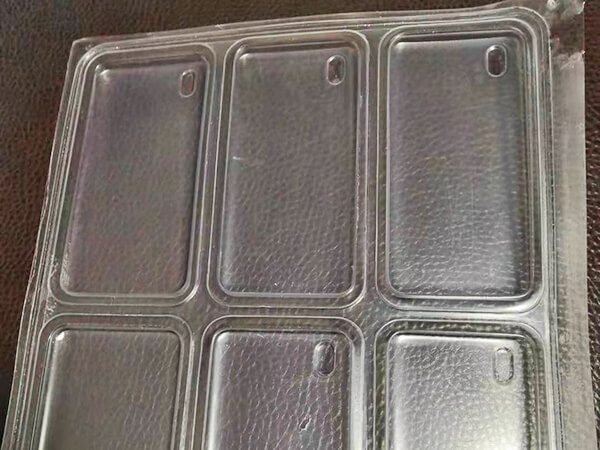
- Consumer electronics: phone cases and housings [S][S], plus IMD samples such as earphone housings, mouse shells and eyeglass frames shown in the SANSEN factory gallery.
- Protective film: automatic hot pressing and slitting of 2.5D screen protectors on the roll-feed hot press [S].
- Smart surfaces: IME builds touch and lighting functions into the decorative film [1][5].

9. Parameters to check when selecting a machine
- Forming method: matched-die hot press or high-pressure gas (see section 6).
- Press force and cylinder type: they set the formable area and pressure stability.
- Effective heating area and table size: they must cover the film blank or multi-cavity layout.
- Temperature range and control: matched to the softening temperature your film needs.
- Maximum daylight, stroke and minimum closed height: they limit tool height.
- Feeding: manual sheet loading or automatic roll feeding (e.g. AS201F-Z).
- Die cutting: a cutting press whose table and force match the forming machine.
The main published data from SANSEN’s original specification tables:
AS201F Servo IMD Hot Press Forming Machine
| Force (T) | 5 / 10 / 30 / 40 / 80 |
|---|---|
| Main cylinder type | Hydraulic HOB (SOB) / Fast master-slave cylinder / SOB / Fast master-slave cylinder / Fast master-slave cylinder / Fast master-slave cylinder |
| Max. mold opening (mm) | 300 / 350/400 / 450 / 500 / 550 |
| Worktable (between columns × plate width, mm) | 450*350 / 600*400 / 800*500 / 900*600 / 1200*600 |
| Effective heating area (mm) | 280*300 / 480*280 / 680*390 / 780*490 / 1050*490 |
| Heating plate power (kW) | 2.5 / 5 / 7 / 8 / 11 |
| Adjustable temperature (℃) | Room temp. – 400 ℃ |
| Control system | Touch screen + PLC |
Figures are taken from the specification tables published on SANSEN’s original product pages (imported into this site). Final specifications are confirmed in the quotation. SANSEN product page →
Gas-Liquid Hybrid IMD Hot Press Forming Machine
| Force (T) | 5 / 10 / 20 / 40 / 80 |
|---|---|
| Max. mold opening (mm) | 300 / 400 / 500 / 500 / 600 |
| Worktable (between columns × plate width, mm) | 450*350 / 600*400 / 800*500 / 900*600 / 1200*600 |
| Effective heating area (mm) | 280*300 / 500*280 / 700*390 / 800*490 / 1050*490 |
| Adjustable temperature (℃) | Room temp. – 350 ℃ |
Figures are taken from the specification tables published on SANSEN’s original product pages (imported into this site). Final specifications are confirmed in the quotation. SANSEN product page →
AS201F-G High-Pressure Gas Forming Machine
| Model (options) | AS201F-G200T / AS201F-G250T / AS201F-G300T / AS201F-G400T |
|---|---|
| Max. clamping force (T) | 200T / 250T / 300T / 200T+200T |
| Worktable size (mm) | 550*550 / 550*700 / 550*800 / 700*1050 |
| Max. high-pressure air (MPa) | 15 |
| IR heating plate area (mm) | 490*490 / 490*610 / 610*740 / 610*980 |
| Max. mold opening (mm) | 380 / 380 / 430 / 500 |
Figures are taken from the specification tables published on SANSEN’s original product pages (imported into this site). Final specifications are confirmed in the quotation. SANSEN product page →
AS201C Servo 3D Die-Cutting Machine
| Force (T) | 5 / 10 / 30 / 40 / 80 |
|---|---|
| Main cylinder type | Hydraulic HOB / Fast master-slave cylinder / HOB / Fast master-slave cylinder / Fast master-slave cylinder / Fast master-slave cylinder |
| Max. mold opening (mm) | 300 / 350 / 450 / 500 / 550 |
| Worktable (between columns × plate width, mm) | 450*350 / 600*400 / 800*500 / 900*600 / 1200*600 |
Figures are taken from the specification tables published on SANSEN’s original product pages (imported into this site). Final specifications are confirmed in the quotation. SANSEN product page →
AS201F-Z Fully Automatic Roll-Feed Hot Press
| Working speed | up to 2,000 cycles/hour |
|---|---|
| Platen parallelism (any point) | within 0.05 mm |
Figures are taken from the specification tables published on SANSEN’s original product pages (imported into this site). Final specifications are confirmed in the quotation. SANSEN product page →
10. Technical FAQ
Can a hot press forming machine do injection molding?
No. It only heats a printed film and presses it into a 3D shape. Injecting resin behind the film is done on an injection molding machine. SANSEN supplies forming and die-cutting machines, not injection molding machines.
What is the difference between IMD and IML?
Ask whether the film stays on the part. If it stays, the process is IML (also called FIM or IMF). If the carrier is peeled off after molding and only the decoration remains, it is a transfer process (IMR, often simply called IMD outside China) [2][5]. In China, IMD is also used as the umbrella term for all in-mold decoration [1].
When should I choose high-pressure gas forming instead of hot press forming?
Consider high-pressure gas forming first for deeper draws, symbols that must land precisely, or matte and textured films [3][4]. Flat or shallow panels can start with hot press forming. Sample with your actual film to decide.
Can one press both form and trim?
SANSEN’s gas-liquid hybrid IMD hot press page states that it can do both forming and die cutting by changing the tool [S]. Send us your part data to check whether that suits your output.
What temperature range do SANSEN machines cover?
From the published tables: AS201F Room temp. – 400 ℃ [S]; gas-liquid hybrid model Room temp. – 350 ℃ [S]; AS201F-G IR heater Room temp. – 500 ℃ [S]. The actual forming temperature depends on the film.
Can roll stock be hot pressed automatically?
Look at the AS201F-Z fully automatic roll-feed hot press. It is designed for roll stock that needs no registration, for hot forming and die cutting, with a working speed of up to 2,000 cycles/hour, for example for 2.5D protective film [S].
What should I send for a quotation?
A 3D drawing or sample, film type and thickness, draw depth, outline size, number of cavities, target output, and whether you also need die cutting. The more complete the data, the better the recommendation.
11. SANSEN machines for this process

Servo IMD Hot Press Forming Machine

Gas-Liquid Hybrid IMD Hot Press Forming Machine

Hydraulic IMD Hot Press Forming Machine

IML / IMD Hot Press Machine

High-Pressure Gas Forming Machine

IMD High-Pressure Forming Machine

Servo 3D Die-Cutting Machine

3D Die-Cutting Machine

Fully Automatic Roll-Feed Hot Press
12. References and sources
- [1] CMF设计|40张图全面专业解析:IML|IMT|IMR|INS|IME等模内注塑工艺. CMF设计军团 · 普象网 Puxiang (puxiang.com) · 2022-08-03. https://www.puxiang.com/articles/e8c593ccaced8be04200c42af12cc3f4 (accessed 2026-11-14). Copyright of the original author; only factual statements are cited, no images or text reproduced.
- [2] In Mold Labeling. Nissha USA. https://nisshausa.com/products/in-mold-labeling/ (accessed 2026-11-14).
- [3] High pressure forming & thermoforming. Covestro. https://www.covestro.com/en/processing-technology/high-pressure-forming-and-thermoforming (accessed 2026-11-14).
- [4] High Pressure Forming – Technology. Niebling GmbH. https://www.niebling-form.com/en/technology/ (accessed 2026-11-14).
- [5] Design Concerns for Durable Products: IML/IMD/IME. Paul O’Hearn (Profile Plastics) · Plastics Decorating · 2022. https://plasticsdecorating.com/articles/2022/design-concerns-for-durable-products-iml-imd-ime/ (accessed 2026-11-14).
- [6] In-Mold Decorating (IMD) and In-Mold Labeling (IML). Scott Sabreen · The Sabreen Group · 2026-10-19. https://sabreen.com/terminology/in-mold-decorating/ (accessed 2026-11-14).
[S] SANSEN product page:
- AS201F Servo IMD Hot Press Forming Machine
- Gas-Liquid Hybrid IMD Hot Press Forming Machine
- Hydraulic IMD Hot Press Forming Machine
- IML / IMD Hot Press Machine
- AS201F-G High-Pressure Gas Forming Machine
- IMD High-Pressure Forming Machine
- AS201C Servo 3D Die-Cutting Machine
- 3D Die-Cutting Machine
- AS201F-Z Fully Automatic Roll-Feed Hot Press
- IMD/IML Air-Conditioner Panel Hot Press Forming Machine
- IML Smart Lock Panel Hot Press Forming Machine
- IMD Phone Case Hot Press
This article was written by SANSEN. The references were used only to check technical facts; no text or images were reproduced from them.
Send us your part drawing, film type and thickness for a free forming and die-cutting assessment